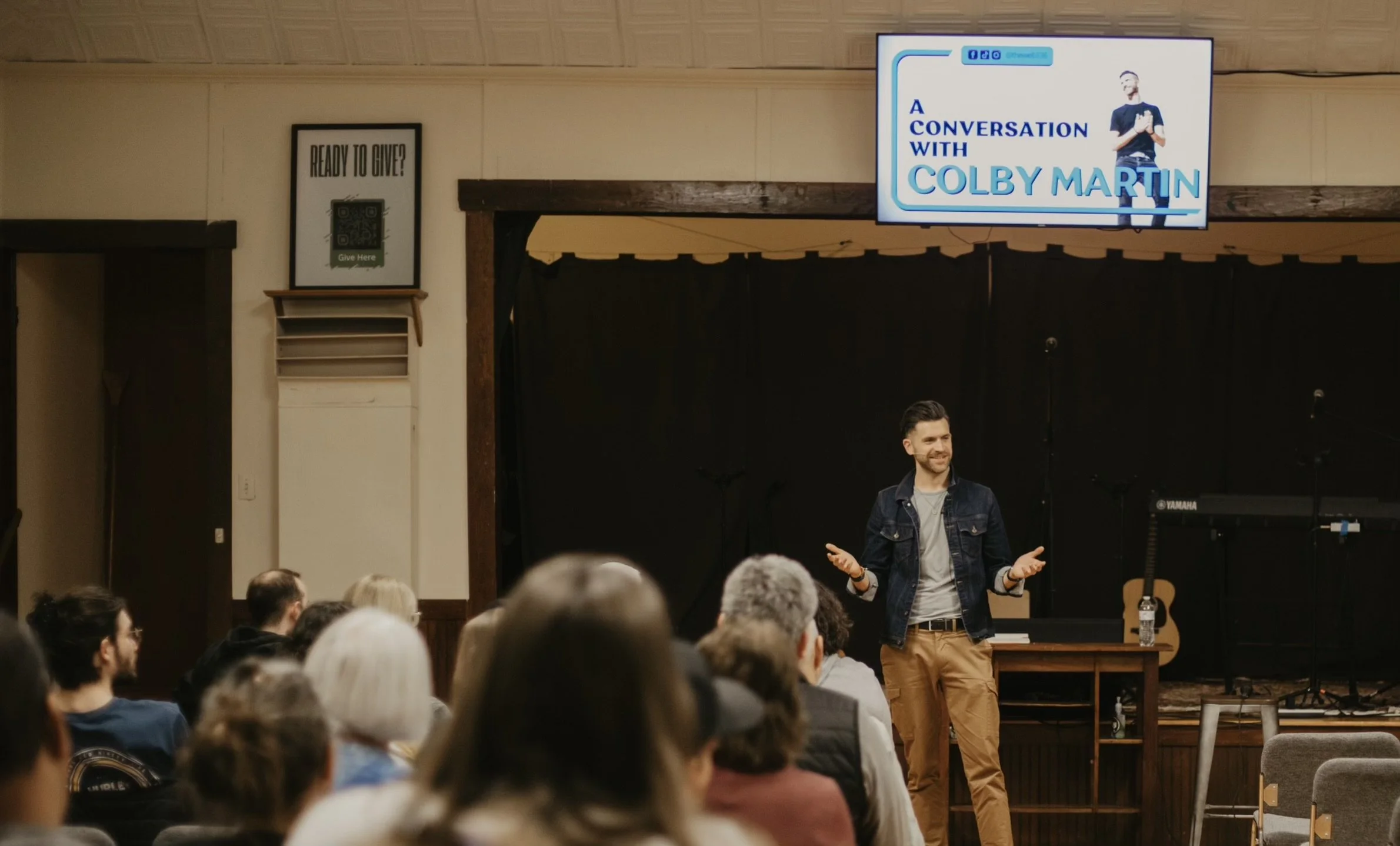
One of my favorite movies from 2012 was the Indie success story and Oscar nominated “Beasts of the Southern Wild.”
As part of our annual God in Film series, I lobbied to get to preach a sermon from this film. I knew I wanted to unpack the way the movie explores death (specifically, the fear of death).
What I didn’t know, is just how much the studying for this message would impact me.
A huge thanks and shout-out to Richard Beck (www.experimentaltheology.blogspot.com) for his amazingly brilliant insights in to our Slavery to the Fear of Death. (Be on the lookout for his upcoming book on the subject. So good!)
So, if you’ve seen the film, and you’re curious where I went with it, then I invite you to give it a listen.
If you haven’t seen the film, then I highly recommend it. And then maybe come listen to my talk. (or vice versa, I guess… doesn’t really matter).
A couple weeks ago I wrote this review for Cross Examined: An Unconventional Spiritual Journey. It’s a novel written by atheist Bob Seidensticker wherein he tries to show how traditional Christian apologetics falls short.
And he writes some really interesting and provocative stuff.
On Tuesday I wrote about the importance of “seeing the other.” And when is the last time you took a chance to really see an atheist? To read what their arguments are? To open up yourself to their critiques of your faith or religion?
If you want a good place to start, then I recommend the “energetic but civil critique of Christianity” from Bob.
And at this moment, all the people who just read that, and who are themselves currently a parent (especially a parent of a toddler) just nodded their heads in agreement.
Parenting your toddlers in public is one of the more challenging things in life. It is almost guaranteed to be a lose-lose situation the moment something goes awry.
Sure, if your kids are having an exceptionally (and for many, rare) well-behaved day, then you just go on about your day.
But the minute you’re out in public and:
- the candy aisle seduces your three year old, or
- her brother took away her stuffed animal, or
- nap time was missed, or
- only God knows why, but they’ve got that look in their eyes
Then watch out.
Because you’re about to be “that” parent, with “that” kid.
And there’s not a thing you can do about it.
Yes, we’ve all been there. But the challenging thing is this: how do you respond?
And in a flash you run through the scenarios: do I come in quick and stern, and try and squash this tantrum before it begins? Well, if I do that, people will think I’m harsh and overbearing, and my kids must be terrified of me on a daily basis. Do I take the calm and patient route, and speak in soft, soothing tones in an attempt to diffuse the situation? Well, if I do that, people will think I’m weak and spoil my kids, and I need to hand-out some discipline every once in a while. Do I choose the speak-to-them-like-an-adult route, and try to reason with them… not too firm, but not too soft… just a steady dose of “reason.” Well, if you do that, chances are people will think you’re being irrational for trying to reason with a screaming child, and they’ll wish you’d either shut them up or give them a hug.
It’s hard. It truly is.
I think we’d all like to convince ourselves that we DON’T think about these things.
That we don’t let how others think of us affect how we parent our kids.
But it’s simply not true.
And it’s not just in public places either. Have you ever been over to a friends house who also has kids, and either A) your kid does something naughty, or throws a toy, or puts their kid in a headlock, or just screams for no reason? or B) THEIR kid puts YOUR kid in a headlock, or steals their toy, or starts acting all cray cray. And again you go in to this crazy mental game of “how the hell do I handle this situation?!” And you start judging THEIR kid, only to realize that in all actuality you just got lucky this time that it wasn’t your kid.
And you watch how other people parent their kids, and you start making assumptions like: if they would just do more/less of “this,” then surely their kids would do more/less of “that.”
But of course, in your more sane moments, you realize that anyone could say the same thing about you.
Public parenting is hard.
And people who have never been parents just simply can’t understand. (sidenote: I realize that comments like that can really bother single people or non-parents. And I get it. But you just have to trust me on this one).
But it’s not just non-parents who often don’t understand, it’s also people who USED to be parents of toddlers and are now all grown up. How often have I felt the judgemental stares of older people, as though THEY were never THAT parent, or THEIR kid was never THAT kid!!!
Not a chance.
Anyways, I love being a dad. More than most things. And our 4 boys are absolutely incredible. (And, in my opinion, really well behaved… most of the time)
But nothing gets my anxiety-muscles flexing quite like trying to navigate those difficult parenting moments in public.
So if you’re out and about and you witness a meltdown by a toddler, do me a favor: cut the parent some slack. It happens to the best of us, and it doesn’t mean we’re awful parents or they are awful kids.
And if you’re a parent of a toddler and you find yourself in that next moment of dealing with a meltdown of your toddler, do me a favor: cut yourself some slack. Doesn’t matter how you handle it, really, because you’ll like get haters on both sides. Just be true to who you are and how you want to raise your kids. And know that parents-of-toddlers around the world are standing with you.
Today is Tai’s 7th birthday.
Tai is our second oldest son, and he is truly a unique and remarkable kid.
His full name is Taieze Alexander Martin.
That’s pronounced “ty – ez,” and it’s derived from the name Taizé (prononced: “tay – zay”).
Taizé is a faith community (a monastery, really) up in the hills of France that is centered on service to the poor, worship, and above all, working towards peace.
It was founded in the early 1940′s as a place where refugees from the war could go for safety, food, and to find reconciliation (including German soldiers, whom society wanted nothing to do with). And since then it has functioned as a place of prayer and service, a beacon of peace to the world.
The brothers of Taizé (sadly, no sisters… yet) take no money and accept no donations. But they travel around the world, meeting with world leaders and religious leaders, to pray and talk peace.
Thousands of young people go on pilgrimages to Taizé every year, staying there for weeks to simply serve (mandatory when you stay there: you’re assigned a job, a role…. no one stays “for free”), pray and worship. They truly find themselves there. (watch this video to see what I mean)
Taizé has, over the years, also developed its own style of music and worship, and this was how Kate and I were first introduced to Taizé.
We were living in Salem, OR at the time, and I saw an advertisement for a Taizé service that was being held at a local Episcopal church. When I started to look in to Taizé, what it was and what it meant, I pronounced the word incorrectly: I pronounced it, “ty – ez.”
Several months later Kate gave birth to our second son. And, not being overly keen on conventional names, we remembered the word (and the mis-pronunciation) of Taizé. So we decided that we would name our son Taieze (ty-ez), the word/name I originally had thought belonged to this faith community in France. Of course, it’s a made up word/name, so we invented a spelling that made sense to us, and we knew that we’d end up calling him “Tai” most of the time.
Brother Roger, who founded Taizé in the early 40′s, was shot and killed 7 years ago during an evening prayer time by a pathological woman. In 2010, the community held a 70th anniversary pilgrimage, and the current Prior of Taizé, Brother Alois, said the following about Brother Roger during a prayer:
He sought earnestly to live in [God's] trust and to express [God's] infinite kindness for every human being, whether a believer or a nonbeliever—you, the living God, who do not condemn, who exclude no one from your love. In this trust, you enabled him to find the source of joy and peace: peace of heart that made him a creator of peace among humans.
So Tai is named after a faith community in France who’s primary mission was and is to promote peace.
Living in to a Name
The other day I was listening to a Freakonomics podcast, and this particular episode was called “How Much Does Your Name Matter?” It gives some interesting data to suggest how the names we give our kids can impact their lives growing up, and how it also says something about the parents who give the names.
One thing that Kate and I have noticed over the years is how Tai has, in an almost freakish way, lived in to his namesake.
Tai is all about peace.
In our house we frame things around “making peace.” (We were inspired by this book called The Peace Book by Todd Parr. If you’re a parent, we can’t recommend Todd Parr’s books enough!) In The Peace Book, Todd talks about all sorts of things that are “peace.”
For instance,
Peace is making new friends
Peace is saying you’re sorry when you hurt someone
Peace is reading all different kinds of books
Peace is thinking about someone you love
Peace is giving shoes to someone who needs them
Peace is planting a tree and sharing a meal
And so on…
Essentially it gives a beautiful picture of how simple, everyday acts, can work towards wholeness, health, and peace.
So in our house, if the boys are fighting with one another, we ask each other, “are you making peace?”
Or we’ll simply shout from the other room, “boys, make peace!” (There’s something odd about SHOUTING for people to MAKE PEACE… oh well)
And Tai has really, really latched on to this concept. He has become an incredible little peace-maker. Something about this idea of making peace just, I don’t know, makes sense to him in a way unique to Tai. Family members and friends who have gotten close to us have remarked how much of a peace-maker Tai is, and it’s always fun to follow that up with the story of his name.
Fifteen Years Down the Road
One of the things that I’m sure sociologists will be studying in the years to come is the relationship between the current generation of people who blog and post things on the internet, with the people/children about whom such things are posted. In other words, when my son(s) are old enough and/or interested enough to Google their name, there’s a good chance it might take them to this blog post. And what an interesting dynamic that will be…
But anyways, Tai, if you are reading this sometime in the future, here’s what I want you to know:
Your mom and I are so incredibly blessed to have you in our lives, in our family. You bring something unique to this world, and everyone who meets you knows it. When you were 6, you used to ask us, “what’s the point of us being here? Why are we alive?” And the only way I knew how to answer you was to say, “there is only one Tai Tai (sidenote: if this is truly 15 years in the future, and your mom and dad are still calling you Tai Tai, well, just deal with it…), there is only one Tai Tai, and if you were not in this world, then this world could not be complete. The world needs you, son. And THAT is why you are here, why you are alive.”
And Tai, if there’s one thing I know, it’s that the world needs more peace.
For that to happen, the world needs more peace-makers.
Jesus once said, “blessed are the peace-makers, for they shall be called the children of God.”
Tai, that is you.
You exhibit, in a truly unique way, what it looks like to be a child of God.
What it looks like to reflect the divine.
I pray you always find yourself to be about the pursuit of peace.
It was my first foray in to the world of doing a talk based on a film and while it was quite the challenge to prepare for (pretty different than a “normal” talk) I will say I thoroughly enjoyed it! And I can’t wait to do it again in a couple weeks with “Beasts of the Southern Wild.”
One of the points I make in the sermon comes from the scene in the movie where Katniss auditions her battle skills for the gamemakers and potential sponsors. You remember that scene: she picks up her bow and arrow and lets loose an arrow at a target, but misses completely. The gamemakers/observers laugh it off and then go about their business (chatting with each other, eating, drinking) and completely ignore Katniss. They were unimpressed and dismissed her, so when she fired her next arrow and scored a bullseye no one even noticed or cared. Annoyed at such indifference towards her, she strings one more arrow but this time shoots it up at where they were all sitting, and fires it straight through an apple that was resting in the open mouth of a cooked pig.
This quite obviously got their attention.
They turn, half amazed and half terrified, and stare at Katniss. She merely says, “for your consideration,” takes a bow, and then exits the arena.
Brilliant scene.
In my sermon I use this scene as an example of creatively choosing a third way when people who are in power over you are ignoring you, oppressing you, or both: not Flight (passively walking away, sulking, and just accepting your lot), and not Fight (shooting arrows AT the people, picking off a few before you’re arrested or killed yourself).
No, she choose a third way.
A way that, essentially said, “Here I am. Right here. And you have to SEE me. I won’t let you ignore me any longer.”
I think that this is, in the Kingdom of God, one of the primary ways that the divide between “us” and “them” begins to dissolve. When people actually “see” the other.
SEE the oppressed.
SEE the forgotten.
SEE the outcast and the outliers.
SEE the ones society ignores.
SEE the ones the church has scorned.
“Seeing” makes all the difference. Or, at least, it’s a really good place to start.
When those who have power/wealth/privilege (the HAVES) remain isolated from those who have-not, then they can remain ignorant of what it actually means to be a have-not.
One of the questions I often pose to people who disagree with me, and are opposed to same-sex marriage or think that all expressions of same-sex attraction are a sin, is this: who do you know that is gay? What same-sex family have you taken the time to really get to know? Have you had them over for dinner? Have you gone to their house, and seen how they live, how they act, how they raise their kids?
Do you SEE them?
Of course, some people respond with, “oh I have lots of gay friends!”
Fine. That may (or may not actually) be true.
But most of the time the answer I get is silence.
No response.
Because they have not gone out of their way to “see” the other.
It’s easier, is it not, to sit in our comfy houses and continue with our non-messy lives. Where the world is easily dividable between “us” and “them.”
Turning around and looking to SEE “them?” That’s hard. That can take work. That can be scary.
But it is oh. so. important.
If you hold the position that gay people don’t deserve equal rights like getting married, then I implore you to get to know a same-sex family. I’m not saying your minds will instantly change, but if you don’t SEE them, then you are willfully choosing to remain ignorant, and you’ll never understand that these are real people.
And for folks like me, who HAVE a degree of power/influence/privilege (i.e. i’m a straight/white/male), part of our challenge is to discover how we can be more like Katniss. How can we get people to SEE, without choosing violence? Without causing more hatred and animosity? What do creative “third ways” look like as we live out this desire to eliminate the us/them divide?
This is a modified and expanded-upon version of a talk I gave at Corban University last year on doubt. This time, speaking at Courtstreet Christian Church in Salem, OR, I unpack a little more about how doubt can be a GOOD thing in the life of a Christ-Follower.
Stretching the Christmas season one more week past Epiphany, I explore the story of the Holy Family fleeing to Egypt to escape Herod. And then, of course, I use that story to talk about corporate worship. Makes sense.
Looking at chapter two of Jonah, where he offers a prayer to God from inside the belly of the sea beast, we can learn a few things about life getting hard. Also, I take the common perception of Jonah the Prophet and casually suggest we’ve gotten it wrong. Are you convinced?
What does the “love” of Jesus look like? I explore the love the that Jesus has for US, as well as what it looks like for us to love LIKE Jesus loved. And then, how can we, as a faith community, illuminate that love to the rest of the world?
This is my first attempt at a God in Film sermon (it’s a sermon series our church does every year). I love the story of The Hunger Games, and I was pumped to dig in to themes like Empire and non-violence. Check it out.
Being still a relative newcomer to Missiongathering, I can say I am stoked to find out that our church does this series every year. Not just because I’m a huge fan of movies, but because I’m a huger fan of thinking critically about art and culture.
I love to explore how things like movies, music and books move us, unsettle us, transform and inspire us.
This Sunday I’ll be kicking off the series as I engage with The Hunger Games.
As I’ve been thinking about and writing the sermon for this week, I wanted to stop and reflect on the reason why we do this.
Why engage with movies like this at church.
So here are some of my thoughts on that.
Breaking the False Divide
If you’ve spent any amount of time (like I have) in the Christian sub-culture, the bubble of conservative christianity, you quickly discover how bizarre it can be.
Everything gets classified in to two categories:
Christian or non-Christian.
The Sacred and the Secular.
Thanks to the world of marketing, we now have:
Christian music and Secular music.
You have Christian books and Secular books.
Christian art and non-Christian art.
And so on…
David Dark, a prolific writer who teaches in Nashville at various institutions, says “there is not a single secular molecule in the universe.”
In David Dark’s book, “Everyday Apocalypse” he challenges us to return to the original meaning of the word “apocalypse:”
Which means “revelation,” or to uncover, to reveal.
And in the book he explores popular movies, t.v. shows, and music to demonstrate how we can look at things in such a way as to discover how there is a sacredness in everything.
He says,
When you begin to view all truthfulness as somehow bearing witness to God’s coming kingdom, you’re gradually able to view all kinds of art much more redemptively than a market-defined “Spirituality” or “Contemporary Christian Music” category can allow.
There is a division that has been created, a FALSE division, between things that belong to the world of “Christianity” and things that are Secular, or non-Christian. One of the things our God in Film series is trying to accomplish is to break down that false, invisible wall. To expose the myth that some things have spiritual value to them, and others don’t. Or that some products are “Christian” and so should be consumed hook, line and sinker… while everything else is secular, scary, dangerous, and to be avoided at all costs.
But it is THIS separation, I would argue, that is thing that is dangerous, scary, and un-biblical (if you’ll permit me to use such a phrase), and it is the creation of these divisions that must be avoided at all costs.
We want to be people who develop eyes to see the Divine in all things. And so as we explore, over the next 6 weeks, these six different films, hopefully as a community we’ll all get some much needed exercise in seeing how everything is spiritual.
(That is NOT to say, of course, that everything is redeeming, or edifying, or has equal value to the soul. That is an equally dangerous position to hold. But that blog post is not this blog post.)
The Power of Movies
Movies are a powerful force, I think you’d agree.
Some movies inspire us to want to become more than we are, to live better stories, to keep moving forward in the pursuit of being the person we really want to be.
Other movies expose the lies that we live. They speak of messages that certain forces in this world would have us believe. That certain things or people can bring us happiness and satisfaction. And we find ourselves confronted with a choice to accept that this movie is either telling us something real about life, or exposing it to be a sham.
Other movies get underneath our skin, and unsettle us, unnerve us. They challenge us to look more closely, more critically at what we think and how we believe.
But movies are, ultimately, a medium for telling stories. And stories are one of the world’s most powerful forces to change people, to inspire transformation. And so God in Film provides us the chance to do a bit of apocalyptic work on some of last years most interesting movies.
To Reveal, really, ways in which we can say, “wait, that’s God!”
Or
“wait, that is NOT God!”
Of course, that begs the question, what does one mean when they say, “That’s God,” or “that’s NOT God.”
And much could be said about that (in fact, if you haven’t already, I invite you read Rob Bell’s newest book What we Talk about When we Talk About God for a fresh way to think about the word, name, and person of God), but I’ll try and sum up just briefly what “I” mean when I say things like “there, there I see the PRESENCE of God,” or “there I see the ABSENCE of God.”
The Presence of God
When I say I see the presence of God in something, what I DON’T mean is that God wasn’t previously present but now IS. I don’t mean that God magically appears in one moment, and then disappears when the moment is over.
We often find ourselves saying things like,
“That was a God moment” or
“Then God showed up”
And while I get the sentiment (and find myself at times defaulting to similar types of expressions), we have to remind ourselves that that sort of language implies that other moments are NOT God moments, or that we are suggesting that God is not in a place most of the time but only shows up when we can see evidence of it.
But I don’t think, if we really stop to consider it, that THAT is what we mean. Or what we really think.
So when I make statements like “seeing God in a movie,” what I’m trying to articulate is that there is something in that scene that resonates in a more obvious and profound way with the things that make me think about God.
Or there’s something about that plot development that echoes with things that I feel represent the character or passions of God: be it the pursuit of justice, or the work of reconciliation, or the process of renewing and redeeming something or someone.
Or, perhaps in a specifically Christian perspective, I might say that there’s something in that character and her choices that reflect the type of life that I see modeled in and taught by Jesus: be it forgiveness or working towards peace or loving the outcast.
And all good movies (all stories, really), in someway or another, tap in to what is true about life. And when that happens, like David Dark says, when we see that all truthfulness somehow bears witness to God and God’s Kingdom, then we can say things like “I saw God in that film.”
The Absence of God
But I think another way we see God in Film is when we DON’T. You could call this seeing the ABSENCE of God.
The PRESENCE of God often lifts us up, inspires us, encourages us… with things like love, redemption, sacrifice, joy, etc…
But films that deal with the ABSENCE of God are often the ones that unsettle us… disturb us… bother us and stick with us for days. Because we see, for instance, in movies like Schindler’s List a certain “that’s-not-rightness.”
When gross injustices are shown on screen, and we stare deep in the face of the evil and wickedness that humankind is capable of, we find ourselves knowing on a profound level that that is not the way it’s supposed to be.
Other times it’s more subtle.
And still other times we might be completely oblivious to it, or we might be downright deceived.
(I think that Romantic comedies often fall prey to this. We often witness a fairytale sort of ending where everything works out and the guy gets the gal, or vice versa, and we leave the theater feeling all warm and fuzzy, and our ears were tickled… but really, we just spent 90 minutes being lied to. Because life ISN’T that way. That’s NOT really love. That’s not how relationships work. And we find ourselves constantly unhappy in life because our brains have been re-wired to expect the world that cinema gives us. But anyways…)
That is the ABSENCE of God.
The telling of a story that wars AGAINST the Kingdom of God.
Looking for God in Film
The God in Film teaching series allows us to engage with the medium of film in a way that invites us to explore how the stories we watch might be tapping in to something beautiful and true about God and God’s Kingdom, OR be exposing stories that war against God’s Kingdom.
This 6 week exploration allows us to exercise our vision to see how everything is spiritual, and to think critically about what it is we are consuming.
Hopefully some of you found this a little helpful with regards to why we do this series every year.
And, if none of that was interesting or helpful, it’s also just a lot of FUN!
So if you’re in the San Diego area anytime during the next 6 weeks, I invite you to join us at 9am or 11am for God in Film at Missiongathering. Or, head over to www.godinfilm.com each week to download the latest message.